Wednesday, May 31, 2017

#151 / Dark Reflections


On December 4, 2016, my posting on this blog was titled, "Bleak Mirror." I teach a Legal Studies "Capstone" course at the University of California, Santa Cruz, and I have focused the course on the issues of "Privacy, Technology, And Freedom." I'm giving my students "Extra Credit" if they watch an episode from the Black Mirror series on Netflix (the series that stimulated my "Bleak Mirror" posting last December), and then provide an online comment. 

I recommend that Black Mirror series to everyone. Black Mirror definitely makes us think about how "technology" affects both our "privacy" and our "freedom." So does Dave Eggers' novel (now a film) The Circle, about which I have commented before, and which I also recommended last December. That recommendation continues in effect!

All too often, we assume that "progress," and especially "technological" progress, is something that takes us forward, and leads us on to a better future. Anyone who has read my blog postings more than occasionally knows that I am skeptical of this bias in favor of new technology. I am particularly distressed with the Silicon Valley idea that "disruption" is always desirable. 

Anyone not familiar with Black Mirror is encouraged to track down this series. There are three seasons, so far, and they are not very long seasons, so if you get hooked it won't take you forever to watch every episode. Netflix has a one month free introduction offer, and you could easily watch them all in that one free month!


Image Credit:
http://www.todaytvseries.com/tv-series/262-black-mirror

Tuesday, May 30, 2017

#150 / Is A Supreme Court Showdown On The Way?


According to the website of a Corpus Christi, Texas television station, from which the image above was taken, "Donald Trump's administration is pledging a Supreme Court showdown over his travel ban after a federal appeals [court] ruled that the ban 'drips with religious intolerance, animus and discrimination.'' 

That decision, and that specific characterization of the president's "travel ban," came on a 10-3 vote of the full 13-member Fourth Circuit Court of Appeals. The Fourth Circuit is based in Richmond, Virginia, which is not exactly the most "liberal" part of the country. The Ninth Circuit Court of Appeals, which is based in San Francisco, has already reached a similar conclusion.

The Wall Street Journal, in a May 26, 2017, editorial, also opined that the president's travel ban is "now teed up for the Supreme Court." The Journal went on to blast the Fourth Circuit's decision on the following basis:

Both the Constitution and statutes passed by Congress endow the President—any President—with broad authority to deny admission to foreign nationals to protect U.S. interests. The courts can narrowly engage, but the Constitution gives the political branches dominant authority on immigration and foreign policy.

Under decades of Supreme Court precedent, the government only needs to show that some immigration action has a “facially legitimate and bona fide” justification. The Trump Administration argues the ban is a temporary pause to improve security vetting, and Congress and even President Obama singled out the six nations in 2016 as countries of concern for exporting terror and increased visa scrutiny.

The Journal's statement of the law, while one-sided, does make a good point. "Deference" to elected officials is the default position of the courts, and never more so than when it comes to the powers of the president to decide on matters of national security. Maybe, as the Trump Administration is promising, there will soon be a "showdown" in the Supreme Court, so the Court can decide whether this kind of traditional "deference" to the president on national security matters should prevail, even if the president's action is dripping with "religious intolerance, animus, and discrimination." 

Maybe that will happen, but if I had to bet, I would bet that there is NOT going to be any "showdown" on these questions. Here's something that not everyone understands. The Supreme Court doesn't have to "take" a case, and to make a decision, unless it wants to. The president, in other words, has no "right" to have his "showdown" in the Supreme Court. 

I, personally, think that the Court might well decide that it would NOT want to validate the president's exercise of his power in this instance, precisely because that would essentially say that his powers are not limited by anything, from common decency to the Bill of Rights. On the other hand, I don't think that the Court would be very wild about the idea of trying to limit the president's powers, either. 

I think (we can all wait to see) that the Court is most likely to dodge the issue. The Circuit Court decisions against the travel ban all render it inoperative. No Circuit Court (at least so far) has said it's valid, so unless the Supreme Court wants to validate an action that most surely does "drip," it can best do nothing, with no prejudice to the future exercise of presidential authority (by a different president).

As I say, let's see where this "showdown" shows up or not! Some informed observers suggest that my prediction - no showdown coming - is quite likely going to prove right. 


Image Credit:
http://www.kristv.com/story/35523409/trump-travel-ban-showdown-headed-for-supreme-court

Monday, May 29, 2017

#149 / History Doesn't Have To Be A Drudge


Today is Memorial Day. I don't pay much attention to holidays, which generally catch me unawares. Thus, I had to check online to make sure. The source I checked, timeanddate.com, starts off its discussion of Memorial Day with a question, which it promptly answers: 

What Do People Do?
It is traditional to fly the flag of the United States at half staff from dawn until noon.

Having received this advice, I settled on using the picture above to top off today's posting. In fact, though, what prompts today's discussion is not the fact that this is Memorial Day. Instead, this posting  is in response to a Peggy Noonan column that ran in The Wall Street Journal on Saturday, May 27, "Why History Will Repay Your Love." It's a nice column, basically devoted to a review of David McCullough's book, The American Spirit, and specifically celebrating the fact that "history doesn't have to be a drudge."

As someone who was a history major in college, with a specific focus on the history of the United States, I applaud and endorse Noonan's sentiment.

I also like the idea that we should celebrate our national holidays by remembering things other than all of the people killed in the almost never-ending wars in which our nation has been involved from before the day I was born until now. If you include the "Cold War," and that seems fair, the United States of America has now been "fighting" from before December 26, 1943, to this very day.

How might our president put it?

SAD!

Actually, that word doesn't even begin to describe what we should all feel about the ongoing and continuous war-related horrors that have been a determining influence on our national life from long ago until now. Some newspapers this weekend carried photos of the Vietnam Veterans Memorial in Washington, D.C., and its understated but eloquent plea to stop the killing:


The more than 58,000 names on the Memorial do not include the names of more than 1.4 million non-Americans who died in that conflict.

American history has had some "positives," too. That is what Noonan's column (and McCullough's book) reminds us. One of the lessons that Noonan suggests we can learn from history is that "nothing had to happen the way it happened."

There is a corollary to that: nothing has to continue the way it's going, either.

Memorial Day is one of those "God and Country" days, and I'm thinking Bob Dylan:

If God’s on our side
He’ll stop the next war

Actually, though, God isn't going to do it. That hasn't worked for the seventy years plus I've been around, and it's not the "next" war we need to worry about at the moment. It's all the wars we are pushing right now.

If God is not going to take care of our war problem, it will be up to us. History is what we make it.

Let's make some history that will repay our love.


Image Credits:
(1) - https://www.theodysseyonline.com/stand-american-flag
(2) - https://www.schuminweb.com/photography/photo-2010/vietnam-memorial/


Sunday, May 28, 2017

#148 / Que Sera


Que Sera, Sera propounds a particular worldview. Click the link to hear Doris Day argue for a rather passive approach to the future:

When I was just a little girl
I asked my mother
What will I be
Will I be pretty
Will I be rich
Here's what she said to me 
Que sera, sera
Whatever will be, will be
The future's not ours to see
Que sera, sera
What will be, will be

Frank Fear is a professor emeritus at Michigan State University, where he served as a faculty member for thirty years. Fear used the picture above to illustrate one of his recent columns in the LA Progressive.

Frankly, I am not totally convinced that the Que Sera, Sera reference was completely apt, with respect to the main point of Fear's argument. I do like the song, though (though I don't buy the deterministic message that Doris Day seeks to advance). I also liked Fear's column. 

The main point of Fear's column was that "the American commonwealth is at risk largely because we (as a country) haven’t invested sufficiently in the power of tailwinds." By "tailwinds," Fear means  "giving poor children more advantages," which he believes (and I believe correctly) "can solve many otherwise intractable problems.”

Here is my invitation to read Fear's column. Just click that link. I think he makes a good case for a number of progressive policies that we ought to be pursuing, and helpfully illuminates one of the main differences between Republicans and the Republican Party and Democrats and the Democratic Party. 

May I invite you, as well, to reject the idea that just because the future is not "ours to see," (an accurate statement, whether propounded by Doris Day or anyone else), it is most definitely not the case that "what will be, will be," at least if that phrase is meant to suggest that there is nothing we can do about the future. 

The future might not be ours to "see," but it is definitely ours to "create."


Image Credit
https://www.laprogressive.com/american-political-divide/

Saturday, May 27, 2017

#147 / Size 19


I have lately become an "Authentic Fan" of the Golden State Warriors. Those who know me are aware that I haven't read the sports pages for fifty years, so they might have doubts. It's definitely a recent thing.

Here is a small proof for the skeptics:

Because of my new "Authentic Fan" status, I am now religiously watching the Warriors' games on television. Watching television is another "recent thing" for me, indulged in, I swear, only with respect to Warriors' games.

In connection with my new television habits, I have been repeatedly exposed to advertisements for KIA automobiles. KIA is the "official vehicle of the NBA." That means "National Basketball Association," for those not yet "authentic."

As it turns out, I have found myself enjoying (and thinking about) one KIA advertisement in particular. The picture at the top of the posting comes from the ad.

You can watch the entire advertisement by clicking on the YouTube video, below: 


This 30-second advertising spot, launched with the hashtag #JustBecauseOptima, features a young man in a shoe store, trying on a pair of sport shoes. He has demanded size 19, and that's what the salesperson brings him. Since those shoes are obviously too large for him, the clerk asks him if he is sure he is not a size 9, instead of a size 19. He dismissively insists that size 19 is the right size, and that he will "wear these out." Which he does, ultimately driving away in his KIA Optima.

The final line of the ad is what has most appealed to me:

Just because you drive the official vehicle of the NBA doesn't make you an official NBA player.

Taken as metaphor, this is good advice for us all. Just because we drive a fancy car, or have a fancy title, or fancy ourselves great in some other way....

That doesn't mean we are!

From our president on down, this is very good advice!


Image Credit:
(1) - https://commercial-song.net/2016/10/kia-optima-commercial-2016-shoe-store/
(2) - Gary Patton personal photo
(3) - https://youtu.be/uJdM86n0qOs

Friday, May 26, 2017

#146 / Skin Cell Babies


The headline on a front-page article in the May 17, 2017, edition of The New York Times caught my eye: "Making Skin Cells Into Babies?" If you click the link, you will find that the online headline is just a bit different, but the article is the same. To the extent that the headline poses a question, the article provides the answer: "Oh, yeah. It's coming. Skin cell babies are on the way. It's just a matter of time!"

My May 17th blog posting was focused on the presidential aspirations of "The Rock," a professional wrestler and film star who is apparently hoping to be our next Chief Executive. My final line of that blog posting came immediately to mind, as I read about the new techniques that can turn our skin cells into babies: 

What could possibly go wrong?

According to the article in The Times (and it's no surprise), the Catholic Church is against the idea of using genetic manipulation to create new human beings. I do believe that these kinds of genetic manipulations pose some important "religious" questions worth thinking about, but "religious" issues are probably not what first pops into most people's minds, as they consider the potential of a technology that turns skin cells into babies. At least, that's my bet. 

I think that the "yuck factor," raised in the article by Arthur Caplan, a bioethicist at New York University, is probably what would first strike many people about this new idea of how to populate the planet. As Caplan says, “It strikes many people as intuitively yucky to have three parents, or to make a baby without starting from an egg and sperm." Caplan, though, goes on to argue that this initial reaction can, or will, be overcome, and all to the benefit of humanity, or so I interpret his remarks: "It used to be that people thought blood transfusions were yucky, or putting pig valves in human hearts.” Not anymore, and thank goodness for that, right?

Human beings can, and usually do, approach life from a purely "pragmatic" or "instrumental" perspective, and this is the perspective I think that Arthur Caplan suggests is appropriate. Will it be useful or helpful to be able to manufacture new human beings from skin cells? It may sound "yucky," initially, but if it "works," why not?

Of course, there is that "what could possibly go wrong?" inquiry. But from a "pragmatic" approach the "what could go wrong?" question just raises the need to be careful, and thoughtful, as we advance this new technology. Sure, something possibly could "go wrong," but let's work to eliminate the potential problems to get the benefits. That's the pragmatic way to deal with the uncertainties of any new technology, from genetic engineering to nuclear weapons. I think this pragmatic approach to the new technology is the response that most people will have to the "yuck" factor, and to the concern that we may not fully appreciate the potential problems that human-manufactured humans could cause. 

Let's just briefly revisit those "religious" questions, however. Those questions are premised, ultimately, on the idea that "pragmatic" approaches to how we conduct ourselves must not be allowed to become the "bottom line" for how we act. 

Killing other people, for instance, is considered "wrong," or "unacceptable," but it is actually a very "pragmatic" way to deal with people, in many situations. You can see the erosion of this fundamentally "religious" principle ("Thou shalt not kill")  in the way police officers seem increasingly to treat confrontations with potentially dangerous persons. Our program of permitting our president to solve perceived terrorist threats by dealing out a "death by drone," based on his personal decision about who should live and who should die, is another example. 

The "pragmatic" way to deal with a situation in which a police officer confronts a potentially dangerous person is for the officer to kill that person. Same with killing possible terrorists who aren't, at least the time they are killed, engaging in any terrorist act. Get them at a wedding, when they're not suspecting it! This idea, that it is "ok" to kill potentially dangerous persons, is not necessarily "nice," but it is a "pragmatic" solution to some real problems. And that is just what is happening, more and more. 

On the other end of the scale, life "creation," as opposed to life "destruction," can be evaluated, as Caplan's remarks suggest, using the same "pragmatic" approach. Caplan is suggesting that turning skin cells into babies has much to recommend it. And maybe it does. However, I think we should consider those "religious" questions, as old-fashioned and "outmoded" as they might seem to be. 

Who are we? That is a fundamental question, and a fundamentally "religious" question. I believe that we are creatures who have been born into life on this lovely Planet Earth. Whether there is a "God" who created us, or our creation depends on some mysterious other process, most usually called "evolution," doesn't really matter much, in the end. The fact is that human beings do not "create" themselves. 

Except, of course, maybe we can, or should, or will in the future. Skin cells into babies? Why not? Once human beings not only feel free to destroy the Natural World, to support activities which we believe will bring us "pragmatic" benefits (and that is our current situation), why not allow human beings to create themselves, too? That's what the skin cells into babies technology really means. Human beings will be manufactured by human beings. We can, finally, truly achieve our desire to fill the role that God, or Nature, seems to have been given in the original conception. 

Deciding to let human beings manufacture other human beings, so we eliminate the idea that we are "creatures" subordinate to a God, or to Nature, raises profoundly "religious" questions. If there nothing inherently "right" about those religious commandments, and if the tests of "pragmatism" are really the only test we need to care about, then the limitations that we have always accepted as basic constraints on our human action may be disregarded.

Is it actually "ok" to substitute human beings in for God, or Nature? This is a "religious" question, to be sure, but I think there is a "pragmatic" inquiry that inevitably comes along with it, for those who think that we should evaluate our human existence from a "pragmatic" point of view. When human beings become manufactured products, instead of the mysterious and miraculous creatures we have always thought ourselves to be, what will be the consequences of that transformation?

What could possibly go wrong?


Image Credit:
https://www.washingtonpost.com/news/speaking-of-science/wp/2016/10/18/scientists-turned-mouse-skin-cells-into-egg-cells-and-made-babies/?utm_term=.b3093314db00


Thursday, May 25, 2017

#145 / MMT


The Nation has recently published an article on "Modern Monetary Theory," or "MMT."

I must confess that I had never heard of MMT until I read the article, which is titled, "Debt Is Not The End." 

Author Atossa Araxia Abrahamian, a journalist based in Brooklyn, says that MMT has a "rock-star appeal" for young people of "the Sanders generation." That makes sense to me. Any economic theory that can promise an end to the debts that are enslaving young college graduates should have lots of appeal. In fact, as I read about MMT, I found it had lots of appeal to me.

I don't want to attempt fully to explain MMT right here. Just click on the link to read what Abrahamian has to say about it in The Nation. I can provide a brief little summary, however, to give you a taste of what MMT is all about. 

As you will see if you read the article, MMT can come across as some sort of economic "magic," since it holds that money is not actually a real constraint on governmental spending. In other words, the government does not actually have to "tax," first, to raise the money it needs for governmental expenditures. The government spends first, essentially creating money by spending it, and then it taxes those who have money to control the inflationary effects of making so much money available in the economy. 

This theory means that social goods can be achieved by a political choice to spend the money necessary to achieve them. If we want to upgrade and repair our infrastructure, we can do it. If we want to provide a college education to those who can benefit from that, we can simply do that. Health care? Mental health care? We can have the kind of health care system we ought to have. Housing? We can build the housing we need to make sure no one has to fight off other homeless persons to be able to sleep under a bridge. Money, says MMT, is not a constraint! Obviously, if this is true, you can see the appeal of MMT!

I do want to make an observation about MMT, which I think is accurate. If I understand how the "magic" works, it works because MMT assumes that we are all in this together, so our collective decisions about what expenditures we should make to achieve our common goals is always the primary question. Resources for governmental expenditures that will benefit the community overall are not what is "left over," using the taxes raised from the "private economy." Our collective economy is the main thing, not the individualistic private economy. 

That kind of does have a sort of "rock star" appeal to me!


Image Credits:
(1) - http://prudentpress.com/finance/fundamentals-of-modern-money-theory/
(2) - https://www.thenation.com/article/the-rock-star-appeal-of-modern-monetary-theory/

Wednesday, May 24, 2017

#144 / Can Wishing Can Make It True?


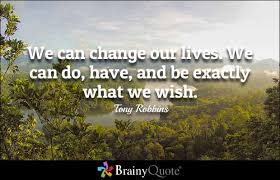
Tony Robbins, who is responsible for the "Brainy Quote" reproduced above, is a "success coach."

What about Donald J. Trump? 

Anyone seriously concerned about the future of the United States of America must surely be asking herself or himself this question: "Why did anyone vote for that guy, and why does he continue to appeal to lots of people?"

I have come to the conclusion that while our president is narcissistic, self-absorbed, a prevaricator, and with little or no understanding of government, he does possess at least one characteristic that has very significant value for those who support him. Donald J. Trump communicates the same "success coach" message that Tony Robbins delivers: "We can do, have, and be exactly what we wish." 

In bringing that message to the nation, President Trump provides very significant value, because while "wishing (alone) can't  make it true," wishing is always the first step. The value of the president's message is in its inspirational qualities, as it tells people that our nation can, in fact, accomplish great things. I am convinced that this positive message is what is sustaining President Trump's popularity. 

The truth is, we CAN "do, have, and be exactly what we wish," in the sense that our human reality is open to infinite possibility. The World of Nature has rules and laws that are not susceptible to modification, but within our world, the world we create, virtually "anything" can be done. Anything for good, and anything for ill. We can build upon our dreams, or upon our nightmares, but our future is always open. As Hannah Arendt says (and I doubt she'd be a Trump supporter), we always possess the ability to do something unexpected, and new, and to begin some new chapter, some new story that has never been told, or heard before. 

Many, if not most, people in the United States are very unsatisfied with our government, and with the state of our social, political, and economic reality. And many people have a sense of despair when they look to the future. 

Our President says that can be changed.

Let's give him credit. He is right about that. And remember that President Trump always says that what will be coming is "huge," "beautiful," "perfect," the "best ever." He says we can "make America great." 

I guess this posting today is just a follow up to my notes on the need to prioritize "insistence" over "resistance," as we consider our political situation.

Those who would like to replace the guy who is currently "in charge" of the Executive Branch had better have a positive program. 

A positive program CAN be accomplished. Our wishes can come true. 

Wishes, of course, are not self-fulfilling. "Corny" quotes contain great truths, at least sometimes! "Wishing" is only step one:


Image Credit:
(1) and (2) - https://www.brainyquote.com/quotes/keywords/wish.html

Tuesday, May 23, 2017

#143 / We Don't Worship Government Either


President Donald J. Trump spoke recently at this year's commencement exercises at Liberty University. Among other things, he said, "In America, we don't worship government; we worship God." Click that link if you'd like to see a video that shows him making those remarks. At Liberty University, those remarks were quite well received.

I have to give the president credit for being half right. In America, it is true that we don't "worship government." Worshipful deference to governmental officials (including the president) is the very opposite of what Americans have historically believed is the right relationship between the people and those whom they select to work on their behalf within the government.

However, the president is definitely half wrong, too, in his statement to the graduates. In America, it is emphatically NOT the case that "we worship God." You might worship God. I might worship God, but "we" (that collective group of us) do not worship God. 

The First Amendment to the Constitution makes that point emphatically. It is the very first statement found in the Bill of Rights. Here is the text, for those who might need reminding:

Amendment I 
Congress shall make no law respecting an establishment of religion, or prohibiting the free exercise thereof; or abridging the freedom of speech, or of the press; or the right of the people peaceably to assemble, and to petition the Government for a redress of grievances.

If you want to worship God, great! If I want to worship God, great. If anyone in the United States wants to worship God, and in any way they seek to do so, great! But is there any obligation to worship God? Can the government make that a test of what it means to be an American? No!

Let me suggest our president do some remedial reading. He could start with the Constitution. Our current president often acts like he thinks he should be given some kind of special deference (you could call it "worship") just because he is the president. And now he is suggesting that "we," all of us, are part of some sort of national worship circle, just because we live in the United States. 

Wrong on the first count. The president gets no special deference.

Wrong on the second count, too: We don't worship God. And we don't worship government, either!


Image Credit:
http://thehill.com/policy/national-security/333217-trumps-war-with-comey-intensifies?rnd=1494627846

Monday, May 22, 2017

#142 / State Of The City


I live in the City of Santa Cruz, and I am quite interested in the "State of the City." I am particularly interested because the City of Santa Cruz seems to be pursuing a number of planning projects that could radically alter the city's current (and historic) shape and character. 

One such project would involve putting high-rise structures on the City's Wharf (the same wharf pictured above). Lots of people (over 2,600 at last count) have joined a "Don't Morph The Wharf" campaign to try to send the message to city leaders that the City should be retaining the historic character of the Wharf, one of the most popular places in the City for both tourists and "locals," alike.

Then there is the plan to put high-rise structures all along the City's main transportation corridors. I was at a Planning Commission meeting last Thursday evening, on that subject, with about 100 persons in attendance. All but two or three of the people who testified indicated a strong opposition to turning Mission Street, Ocean Street, Water Street, and Soquel Avenue into high-rise "corridors," where existing structures would be torn down in favor of new "mixed use" buildings going up to 55 and 65 feet in height. 

The City planning staff and the project consultant for the so-called "corridors plan," seemed to promise lots of "community benefit," but it's not too clear what the "benefit" might be, since the plan is certainly not good for the existing "community." 

The current proposal would have very adverse impacts on traffic (already horrendous) and make the adjoining residential neighborhoods much less livable. Those neighborhoods, of course, are where members of the "community" actually live. Those community members are not seeing any future "benefits" to them, from this so-called "corridors plan," and they wonder just who is going to benefit. 

(Stay tuned, I have an idea that I'll share at the end of this blog posting). 

Maybe the worst part of the so-called "corridors plan," besides its basic feature of helping to turn Santa Cruz into a seaside version of San Jose, is the impact that the plan would have on real estate prices, driving them ever higher, and thus making it even harder than it already is to find, or build, affordable housing. The new development on Darwin Street, shown below, began with the tear down of an existing home, and this kind of "development," exactly what would be promoted by the so-called "corridors plan," will most emphatically not give us more affordable housing. Rents for the new units pictured below will be over $3,700 per month.


oooOOOooo

Anyone interested in that so-called "Corridors Plan," by the way, should probably mark their calendar, and plan to show up at the Planning Commission's next meeting, scheduled for Thursday, May 25th, at 7:00 p.m., at the Santa Cruz City Hall. 


oooOOOooo

STATE OF THE CITY SPEECH

Yesterday, on Sunday morning, I learned from a bulletin in our local newspaper that a "State of the City" presentation will take place tomorrow, on Tuesday, May 23rd. Here's what the paper said: 

Santa Cruz Mayor Cynthia Chase, City Manager Martín Bernal and city department heads will deliver the city of Santa Cruz’s State of the City address from 8:30-10 a.m. Tuesday at Hotel Paradox, 611 Ocean St. A continental breakfast will be served. [In fact, it costs $15 to get in, and seating is limited].
The address will provide an update on city achievements, challenges and initiatives to strengthen Santa Cruz as a place to do business (emphasis added).

I think there is something wrong with the fact that our elected and non-elected city officials are reporting on the "State of the City" in what amounts to a private meeting, held at an upscale hotel, scheduled during the working day when most people can't attend, and with a $15 ticket price to get in. 

Having been an elected official myself, I think these "State of..." events should be public, not private, and should address members of the "community." After all, the officials giving the report are supposed to be working for them. Members of the community shouldn't have to pay, either, to hear from their own local officials about what is going on.

Look at that last paragraph, though. I think that gives the secret away. This meeting doesn't appear to be focusing on "achievements, challenges, and initiatives" that respond to the City's residents, or to the "community." Instead, this is a meeting focused on how to "strengthen Santa Cruz as a place to do business." 

Nothing wrong with business, but the purpose of a City is not to benefit business. It is to benefit the community at large. 

Thinking about that so-called "Corridors Plan," it is pretty clear that business people and developers will just love what the so-called "Corridors Plan," would do for them. For the rest of us, though - for the "community" that lives in Santa Cruz now - there is a whole different answer.

If the "State of the City" is that finding out how best to give "benefits" to business is the City's main objective (as opposed to focusing on what benefits the community at large), then we have a big problem around here!


Image Credits:
(1) - https://www.eventbrite.com/e/state-of-the-city-tickets-33900078046
(2) - https://www.trulia.com/rental/4015632629-716-Darwin-St-102-Santa-Cruz-CA-95062#photo-2

Sunday, May 21, 2017


#141 / Apocalypse   Now  Soon

On Sunday, April 30, 2017, Salon published an article titled, "It’s the end of the world and we know it: Scientists in many disciplines see apocalypse, soon." Click the link to read a pretty depressing catalogue of potential dangers to the continued life of human beings. Stephen Hawking was cited as a scientist who is forecasting "the possible near-term demise of our species." 

Salon thought it was particularly chilling that current apocalyptic predictions are coming from "scientists," instead of from religious practitioners or prophets of various stripes. "This is a worrisome fact," said Salon, "given that science is based not on faith and private revelation, but on observation and empirical evidence." 

Salon's advice, given the circumstances? "Spend that 401k!" 

I would like to suggest an alternative way to think about the "scientific" predictions being made about the end of the world, and I want specifically to disagree with the idea that since scientific predictions are based on "observation and empirical evidence" they are better predictors of the human future than predictions based on "faith." 

"Scientists" are generally given that title because the people we call scientists study some aspect of the Natural World. This is a worthy occupation, of course. However, the Natural World is a world that is governed by "laws" that are "predictive" and "descriptive." In the Natural World, a world that we did not create, the rules that govern what happens are not susceptible of alteration. In the natural sciences, it's not a "law" unless it accurately describes what will (always) happen. "Scientists," accordingly, have a mindset that naturally assumes that what IS happening MUST happen, because that is, in fact, how the Natural World is organized. 

The human world works on a different principle. In the human world, which we do create, the "laws" are not "descriptive" of what must, inevitably, happen. Our laws are "prescriptive." They state not what "will" happen, but what we "want" to make happen. We create the human world, which is the world we most immediately inhabit, and while our world is dependent on the World of Nature (something we forget at our peril), the human world is a world of incredible "freedom." Wishing won't make things happen, but by stating what we "wish" for, what we say we want, we take the very first step to making it happen in fact. 

Thus, we are not "observers," as the "scientists" are. We are "actors" and "creators." The "empirical facts" that state inevitabilities in the World of Nature are merely factors to consider in the world that we create. 

Let's be clear. Most of the threats accurately outlined in the Salon article are threats related to massive changes in the Natural World, and the laws that govern that World of Nature state inevitabilities; these "natural laws" are the cause of the changes in the Natural World that are putting our human world at risk. That's definitely the "bad news."

The "good news" is that most of the changes in the Natural World that are threatening the demise of our species are changes that have been caused by human action. And there is nothing "inevitable" about human action. What we have done in the past, and are doing now, we can do differently in the future. And that actually means immediately, since "the future" and "now" meet in every instant we are alive.

I guess maybe a little "faith" that we could, in fact, do something different might be a really good resource, right about now, because it is clear that the scientists are right that if we don't do something different in the future (meaning right "now") we will be destroyed by the consequences of what we have done in the past, and what we are continuing to do.

Despite the brilliance of Stephen Hawking, let's not move to Mars just yet! Let's wait a bit before we cash in our 401k.

I am told it's a myth that the Chinese character for "crisis" is composed of a combination of the characters for "danger" and "opportunity," but if that description is not strictly true, it's certainly metaphorically accurate. 

We (those alive now) are in mortal danger. The "scientists" are right about that. 

And we (those who live now) have a chance, have an opportunity, to transform all that we have done before, and to create a different world entirely. With a little "faith," we can live, at last, within the sacred limits of this beautiful Earth. When we do so, we can celebrate our life, within the World of Nature, and give thanks to the Life and to the World into which we have been so privileged to have been born. 


Image Credit:
https://yesmovies.to/movie/apocalypse-now-redux-19582.html

Saturday, May 20, 2017

#140 / The Drawdown Project


A few weeks ago (see the picture above), scientists and their supporters held a "March For Science" in Washington, D.C. Similar marches were held around the country, and in fact around the world. There was a "March For Science," for instance, in my own home town of Santa Cruz, California: 


What science tells us about global warming is that we are well on our way towards a massive extinction event, and that our own extinction is likely to be imminent. Our failure to recognize that the World of Nature has built in laws and limits that we must respect is putting human civilization in peril. 

The chart below comes from "The Great Change" blog. It's a little hard to read, even in the original, but it depicts the long trajectory of geological history, and illustrates the following proposition: 

We are in a crisis in the evolution of human society. It’s unique to both human and geologic history. It has never happened before and it can’t possibly happen again.


Paul Hawken, the creator of a series of "ecological businesses," thinks we need to do more than merely "slow down," or "mitigate" the global warming that is putting  our human future in peril. Science definitely supports that assertion. Hawken also thinks he has a prescription that might work. He is calling his plan Project Drawdown. Hawken claims that this is, in fact, the "World’s First Comprehensive Plan to Reverse Global Warming."

Hawken spoke recently, in San Francisco, and outlined Project Drawdown. 

If you like science, you should like this: 


Image Credit:
(1) - https://www.nytimes.com/2017/04/22/science/march-for-science.html?_r=0
(2) - https://www.facebook.com/cynthia.mathews.10/posts/10156419812428018
(3) - http://peaksurfer.blogspot.com/2017/04/change-agents.html

Friday, May 19, 2017

#139 / When You Can See It Coming


This picture is from an article in The New York Times. Taken in 2013, the photograph is the last image ever captured by twenty-two year old photographer Hilda Clayton. The mortar explosion shown in the photograph killed Clayton. It was an "accident," occurring during a "training exercise." She and four Afghan soldiers died. The article in The Times is worth reading. 

It is also worth thinking about the photo as a visual metaphor. We are all behind the lens, watching and recording dangerous exercises that might well kill us. 

Think about global warming. Think about the many, various, and escalating military involvements in which our nation is ever more deeply engaged, including the conflict in Afghanistan that led to Clayton's death. Think about the continuing threat of nuclear war. 

If you think about it that way, this photo is a metaphor. We can see it coming, just like in the photo. Unlike the photo, though, we know it's coming before we actually see it in fact. 

If you know it's coming, you don't have to wait around until it's too late. 

We might be able to change what we're doing before the bombs blow up.


Image Credit:
https://www.nytimes.com/2017/05/05/us/hilda-clayton-army-photograph.html

Thursday, May 18, 2017

#138 / Chicken Or Fish


I am not much of a fan of Thomas L. Friedman, a columnist who writes in The New York Times. I did like his column yesterday, though. It was titled "It's Chicken Or Fish." I encourage you to click the link and see what Friedman has to say about the President's firing of FBI Director James Comey. Here is Friedman's opening salvo: 

Since President Trump’s firing of F.B.I. Director James Comey, one question has been repeated over and over: With Democrats lacking any real governing power, are there a few good elected men or women in the Republican Party who will stand up to the president’s abuse of power as their predecessors did during Watergate?  
And this question will surely get louder with the report that Trump asked Comey in February to halt the investigation into the president’s former national security adviser. But we already know the answer: No.  
The G.O.P. never would have embraced someone like Trump in the first place — an indecent man with a record of multiple bankruptcies, unpaid bills and alleged sexual harassments who lies as he breathes — for the answer to ever be yes. Virtually all the good men and women in this party’s leadership have been purged or silenced; those who are left have either been bought off by lobbies or have cynically decided to take a ride on Trump’s Good Ship Lollipop to exploit it for any number of different agendas....  
There will be no G.O.P. mutiny, even if Trump resembles Captain Queeg more each day.

Remembering that opening salvo, here's Friedman's bottom line conclusion:

Democrats and independents should not be deluded or distracted by marches on Washington, clever tweets or “Saturday Night Live” skits lampooning Trump. They need power. If you are appalled by what Trump is doing — backed by House and Senate Republicans — then you need to get out of Facebook and into somebody’s face, by running for Congress as a Democrat or an independent, registering someone to vote for a Democrat or an independent, or raising money to support such candidates. 
Nothing else matters.

I don't really "get" the "Chicken Or Fish" dichotomy. But what Friedman says about the need to mobilize political power to change our politics?

That I get. 

And I agree with Friedman's conclusion, too.

Nothing else matters.


Image Credit:
http://www.wisegeek.net/what-is-good-protein.htm#

Wednesday, May 17, 2017

#137 / And Now, Appearing Next....


Here is a guy who is getting ready to run for President in 2020. Really!

His name is Dwayne Johnson, though I guess he is better known as "The Rock." He is a professional wrestler, but has broken into the movies, too

Johnson's picture to the left is from Baywatch, a popular television show in which he appeared. He seems to be another Arnold Schwarzenegger, in terms of his upper body build and his apparent penchant for politics. 

The "Rock For President" drive began with a Washington Post columnist, Alyssa Rosenberg, who kicked it off with her column dated June 7, 2016

Rosenberg has recently said that her column was "lighthearted," and a "joke," but The Rock is certainly taking the idea seriously. In a comment that appeared in The Post on May 10, 2017, Johnson said it was about a year ago, around the time Alyssa Rosenberg published her essay explaining why Johnson would be a viable candidate, that the actor began thinking about running for office more seriously. He has, in fact, most recently discussed his political future in an article in Gentlemen's Quarterly. The article is titled, "Dwayne Johnson For President!" Looks like a movie set, and The Rock is in the starring role:


Johnson can clean up nicely, as demonstrated by the photograph below, which accompanied the original Rosenberg "joke" essay: 


Why should we worry? Why should we doubt?

The Rock is a television and movie personality, with roots in professional wrestling. We know that works, politically.

What could possibly go wrong?


Image Credits:
(1) - https://www.youtube.com/watch?v=GWoX7bnOnac
(2) - http://www.gq.com/story/dwayne-johnson-for-president-cover?wpisrc=nl_act4&wpmm=1
(3) - https://www.washingtonpost.com/news/act-four/wp/2016/06/07/dwayne-johnson-says-he-might-want-to-run-for-president-he-could-actually-win/?utm_term=.d89adb4493cf&wpisrc=nl_act4&wpmm=1

Tuesday, May 16, 2017

#136 / Resistance Versus Insistence


Pictured above is Tom Perez, who serves as Chair of the Democratic National Committee. The DNC runs the Democratic Party. The photo is from an article by Gerald F. Seib, in his "Capitol Journal" column in The Wall Street Journal. Seib's column was titled, "Democrats Ponder New Tactic Against Trump." That is the title used in the print edition. "Democrats Ponder Whether Resisting Donald Trump Is Enough" is the title that appears in the online edition.

As Seib notes, the Democratic Party response to Donald Trump has been couched as a strategy of "resistance." This strategy is supported by Bernie Sanders, who did not win the Democratic Party nomination last year. "Resistance" is now also supported by Hillary Clinton, who did

"Resisting" the President and his various governmental efforts does seem appropriate. The President is trying to dismantle our system of environmental safeguards, and not only ignores the threat of global warming, but actively promotes policies that will make things worse. He is attacking our health care system, hurting poor people, while he urges tax cuts for the extremely wealthy. He is making makes moves towards a nuclear confrontation with Korea, and seems clearly committed to trying to solve complex international problems with military intervention. He is narcissistic to a dangerous degree, and his Administration is also rife with apparent corruption and conflicts of interest. 

Resist all this? Sure!

It should be noted, however, that the Clinton campaign was pretty much based on personal opposition to Donald Trump the candidate. That didn't end up working very well. It should also be noted that despite what Trump opponents see as a disastrous beginning to the Trump presidency, a record that definitely indicates that "resistance" is required, the vast majority of those who supported Trump the candidate continue to support Trump the president. There is a serious question whether more "resistance" is going to change their minds, and alter the current state of our politics.

I suggest that "resistance," while necessary, is not going to be sufficient. Those who believe that what the president is trying to do is profoundly wrong need to get beyond "resistance" and criticism, and promote a positive program of the political changes we actually need. 

I think any winning political strategy, in other words, must be based on "insistence," not "resistance." 

We must insist that economic inequality will be eliminated. We must insist that we protect the natural environment. We must insist on health care for all. We must insist on an international strategy based on peacemaking, not military conflict. We need affirmative programs for housing, for education, for health care, and for global solidarity in the face of the immense food, climate, water, and civil unrest challenges. A real and specific program around these issues can and must be developed, and we must insist that political changes be made to accomplish the affirmative, positive, and possible ideas that can, literally, transform the world, when we work together. 

If the Democratic Party won't develop and promote such a positive program, insisting upon it, in fact, all the resistance in the world won't change what's happening to our politics. Unless we insist on transforming the social, economic, and political realities that now prevail, our future as a democratic republic is at grave risk.


Image Credit:
https://www.wsj.com/articles/democrats-ponder-whether-resisting-donald-trump-is-enough-1493654574

Monday, May 15, 2017

#135 / Take Some Advice From Donald J. Trump


I am not a big fan of "American Exceptionalism," and I am particularly not a big fan when the term is used in the third sense listed by Wikipedia, in its article defining the term

American exceptionalism is one of three related ideas. The first is that the history of the United States is inherently different from that of other nations. In this view, American exceptionalism stems from the American Revolution, becoming what political scientist Seymour Martin Lipset called "the first new nation" and developing the uniquely American ideology of "Americanism,"based on liberty, egalitarianism, individualism, republicanism, democracy, and laissez-faire economics. This ideology itself is often referred to as "American exceptionalism." Second is the idea that the U.S. has a unique mission to transform the world. Abraham Lincoln stated in the Gettysburg Address (1863) that Americans have a duty to ensure that "government of the people, by the people, for the people, shall not perish from the earth." Third is the sense that the United States' history and mission give it a superiority over other nations.

Juliana Geran Pilon is not a big fan of "American Exceptionalism" either. If this is a topic that you think merits some attention,* you will probably be interested in Pilon's recent Opinion Editorial in The Wall Street Journal: "Let's Take Exception to the Term 'American Exceptionalism.'"

Pilon says that the term "American Exceptionalism" originated with Stalin. That's news to me - and I bet it's news to you, too! I was happy to get this background briefing, but what I found most compelling in Pilon's article was what she said about Donald J. Trump. I think that the quotations below show that candidate Trump, now our President, was right on target:

Candidate Donald Trump ... didn’t care for the term [American Exceptionalism]. As he told a group of Republicans in 2015, he thought it impolite: “I don’t want to say, ‘We’re exceptional. We’re more exceptional.’ Because essentially we’re saying, ‘We’re more outstanding than you . . .’ ” [Trump] also questioned the premise: “We’re dying. We owe 18 trillion in debt. I’d like to make us exceptional. . . . We may have a chance to say it in the not-too-distant future. But even then, I wouldn’t say it. . . . Let’s not rub it in.”

_________________________________________________
* I have paid some attention to "American Exceptionalism" in at least five postings in this blog: once on July 10, 2010, once on November 23, 2013, once on February 26, 2014, once on June 7, 2014, and most recently on May 1, 2017.  I definitely think we need to pay attention to what seems to be an American tendency to claim superiority (and thus the right to rule the world). Let's hope our current president remembers the insight he demonstrated as a candidate.

Image Credit:
https://www.youtube.com/watch?v=1XuhzdpgiTA