Friday, January 31, 2025

#31 / Here's A Warning (For Immediate Action)


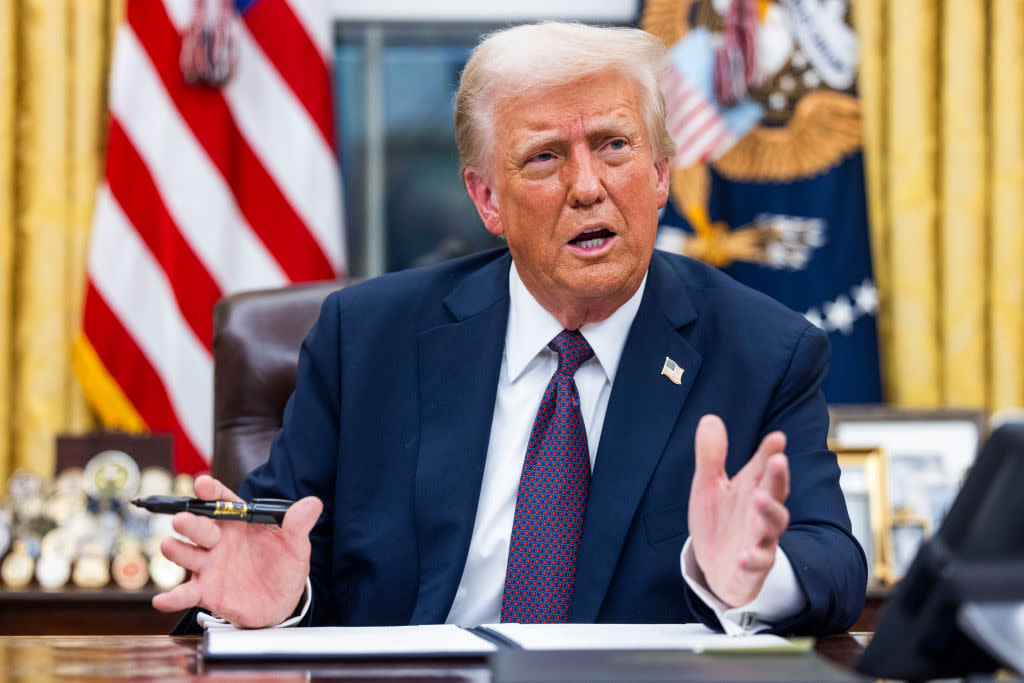
Pictured is Russell Vought, who has been nominated by president Trump to head the Office of Management and Budget (OMB)

As a supporter of Indivisible (you are cordially invited to sign up), I received the advisory I am republishing below, and which I am passing along here. The bulletin from Indivisible is "time sensitive," and when you see this posting, I hope you will immediately follow up on its recommendations. This particularly applies if you happen to live in a state other than California. I believe that California's two Senators will vote against Vought's appointment, but it never hurts to let your elected officials know your feelings!

Here is the Indivisible bulletin: 

Today, some of the most extreme, unqualified, and dangerous cabinet nominees in the history of the republic appear before the Senate for their confirmation hearings. 
Kash Patel, a MAGA-true believer who has salivated about prosecuting members of the media and helped produce a rendition of the "Star-Spangled Banner" sung by violent January 6 inmates (pre-pardon), will make the case for leading the FBI. 
Tulsi Gabbard, a Putin apologist with no real intelligence experience, a person who was denied sensitive information while in Congress because colleagues feared she’d leak it to her pal and deposed war criminal Bashar al-Assad, will explain why she should be trusted to be the next Director of National Intelligence. 
RFK Jr., a man who buys into some of the most bizarre conspiracy theories imaginable, backs a national abortion ban, faces sexual assault allegations, and whose healthcare experience includes (or is limited to) exacerbating a deadly measles outbreak with his vaccine denialism, will be back on the Hill as he seeks to lead the Department of Health and Human Services. 
But this email isn’t about any of them. Yes, you should absolutely call and email your senators to urge them to vote NO on all three. We’ve got tools to help you do it here
This email, however, is about another extremely dangerous nominee who has garnered far less attention -- and whose confirmation could be voted on by the full Senate as early as tomorrow. We’re talking, dear friends, about Project 2025 architect, mastermind behind Trump’s sweeping (and illegal) spending freeze, and nominee to lead the “nerve-center” of the federal government -- Russell Vought.  
Let’s back up. 
If you’ve been following our emails or checked the news this week, you’re aware that on Tuesday, Trump’s Office of Management and Budget issued a memo freezing virtually all federal spending -- funds allocated by Congress for things like Medicaid, housing assistance, scientific research, food for hungry families, and a million other things. 
These were funds that the Constitution does not allow the president to withhold. So before the freeze was set to take effect (and after a tremendous amount of chaos and fear was unleashed), a federal judge blocked it. Then, amidst massive public backlash, and nonstop calls to House and Senate offices (thanks to all of you), the White House backpedaled and rescinded the memo. 
We wish that were the end of the story. But it is not. Quickly after the memo was rescinded, Trump’s press secretary volunteered that they were only rescinding the document, not the intent behind it. That statement was confusing, but clear enough about the administration’s illegal intentions that another judge felt the need to issue a second order blocking the funding freeze. 
Obviously, the administration bungled this. And clearly, they’re not done trying. That’s why Trump wants Russell Vought at the helm of OMB. 
What does Vought have to do with the funding freeze? Well, the entire concept is kind of his "Hot to Go" (or depending on your generation, perhaps his "Free Bird"). Read his academic writings, and he waxes on about the president remaking government by withholding funds from programs that don’t align with his ideological agenda. Watch his Senate hearings, and he croons about the president’s right to do it, Constitution and Supreme Court guidance be damned. 
In fact, while serving as OMB Director for a brief time during Trump’s first term, he tried it on a much smaller scale -- freezing funds allocated for Ukraine (an impeachment resulted). The move was later deemed blatantly illegal. 
The Office of Management and Budget is often called the "most important agency you’ve never heard of" because it really does hold a lot of power -- coordinating policy across all government, overseeing budgets, and more. 
Russell Vought has an even more expansive view of the agency’s power -- he views it the “nerve center” of the federal bureaucracy and believes that under the right leadership (his), it can totally bypass Congress and give Trump king-like powers. He wrote an entire chapter about it in Project 2025 -- the Heritage Foundation blueprint for an autocratic second Trump term. You may recall Trump disavowing the plan on the campaign trail. But surprise, now that he’s president, he’s seeking to install its authors in the highest positions of government. 
If Vought is confirmed, chaotic funding freezes like we saw this week will only be the beginning. Together, Trump and Vought will seek to transform the government into a tool of far-right ideology, Christian Nationalism, and political revenge against Trump’s enemies. 
We’ll be honest. Vought is not going to be the easiest of Trump’s nominees to block. His MAGA bona fides and extensive experience in Washington give him a lot of cred with Republican senators. 
But this week, senators also witnessed his plans put into action -- and the mayhem it caused in their states as millions who rely on government grants nearly had their lives, businesses, and education upended. All senators, especially Republican senators, need to understand that a yes for Vought is a yes for the exact funding freeze that was just rescinded. 
No amount of expert questioning during a senate hearing could have better illustrated the danger Vought poses. We all witnessed it. Now, it’s up to us to make sure senators don’t hear the end of it -- and to demand they vote no.  
In solidarity,
Indivisible Team
[January 30, 2025] 
 

Thursday, January 30, 2025

#30 / The Artificial State


I think that Jill Lepore, pictured above, is probably my favorite living historian (she is a lawyer, too). Lepore teaches at Harvard University, and at the Harvard Law School, and if you are not familiar with her work, I hope you will track down her books and get acquainted. Lepore's writings are well-researched, and deeply thought out, but they are not either "legalistic" or "academic" in their tone or presentation. I count that as a positive, myself!

Recently, Lepore published an article as a "Critic At Large" in the November 11, 2024, edition of The New Yorker. Her article was titled, "The Artificial State." Nonsubscribers may or may not be able to access the article by clicking that link. It is an important article, and I hope that those reading this blog posting will be able to read it in its entirety. Suspecting that this might not be possible for many, I have excerpted enough of the article, immediately below, to give you the main idea (emphasis added): 

Since the nineteen-sixties, much of American public life has become automated, driven by computers and predictive algorithms that can do the political work of rallying support, running campaigns, communicating with constituents, and even crafting policy. In that same stretch of time, the proportion of Americans who say that they trust the U.S. government to do what is right most of the time has fallen from nearly eighty per cent to about twenty per cent. Automated politics, it would seem, makes for very bad government, helping produce an electorate that is alienated, polarized, and mistrustful, and elected officials who are paralyzed by their ability to calculate, in advance, the likely consequences of their actions, down to the last lost primary or donated dollar. 
Kamala Harris’s 2024 campaign was vastly influenced by the data-driven ad tester Future Forward, the biggest PAC in the United States. Donald Trump, for all his piffle about his indifference to data, is as much a creature of automated politics as anyone. The man doesn’t stay on message, but his campaign does. The 2016 Trump campaign hired Cambridge Analytica, which exploited the data of up to eighty-seven million Facebook users to create targeted messaging. “I pretty much used Facebook to get Trump elected in 2016,” a Trump campaign adviser, Brad Parscale, boasted. This year, the R.N.C. is working with Parscale’s A.I. company, Campaign Nucleus. And although the Trump campaign insists that it “does not engage in or utilize A.I.,” it does use “a set of proprietary algorithmic tools.” ... 
These days, Americans are worried not only about this election but about this democracy and its future. In September, the Stanford Digital Economy Lab, part of the Stanford Institute for Human-Centered Artificial Intelligence, released “The Digitalist Papers: Artificial Intelligence and Democracy in America,” billed as the Federalist Papers for the twenty-first century. Most of the essays, chiefly written by tech executives and academics, advance the theory that the automation of politics through artificial intelligence could save American democracy. Critics take a rather different view. In the book “Algorithms and the End of Politics: How Technology Shapes 21st-Century American Life,” the political economist Scott Timcke, using Marxism to look at Muskism, argues that “datafication”—converting “human practices into computational artefacts”—promotes neoliberalism, automates inequality, and decreases freedom. 
The artificial state is not a shadow government. It’s not a conspiracy. There’s nothing secret about it. The artificial state is a digital-communications infrastructure used by political strategists and private corporations to organize and automate political discourse. It is the reduction of politics to the digital manipulation of attention-mining algorithms, the trussing of government by corporate-owned digital architecture, the diminishment of citizenship to minutely message-tested online engagement. An entire generation of Americans can no longer imagine any other system and, wisely, have very little faith in this one. (According to a Harvard poll from 2021, more than half of Americans between the ages of eighteen and twenty-nine believe that American democracy either is “in trouble” or has already “failed.”) Within the artificial state, nearly every element of American democratic life—civil society, representative government, a free press, free expression, and faith in elections—is vulnerable to subversion. In lieu of decision-making by democratic deliberation, the artificial state offers prediction by calculation, the capture of the public sphere by data-driven commerce, and the replacement of humans with machines—drones in the place of the demos.

In talking about "The Artificial State," Lepore is really telling us how normal, person-to-person conversations and discussions have been replaced by one-way, algorithmic communications that take place on platforms that are owned by and serve the interests of gigantic, private corporations. Tip O'Neill, long time Speaker of the House of Representatives, was famously known to say, "all politics is local." Not now, says Lepore. Not in the "Artificial State."

My diagram of how government works goes this way: 

"Politics > Law > Government." 

In other words, we are "a government of laws," but the laws that define and determine what the government does are not like the laws of physics. The laws that establish and implement our "government" are the product of our politics. 

If you agree with Lepore's analysis, and if you give credit to that diagram of mine, then it is clear why we all need to get much more personally involved in politics. We absolutely must insist upon our personal and direct participation. We need to practice politics in "real life," through contact with real people, and not by way of TikTok, or "X," or any other online media.

I don't think there is a shortcut. If we want a politics and government that works for us, instead for the giant corporations that own and operate those online platforms; if we want a politics that inspires confidence, rather than the opposite, and a politics that can pull us together effectively to address the incredibly difficult problems we face, then "artificial" substitutes won't work. Instead, we are going to have to get involved in politics ourselves. Of course, that is only a requirement long as we want "self government," not manipulation by hidden forces beyond our individual control. 

And... I do want that! I hope you do, too.


Wednesday, January 29, 2025

#29 / No One Can Afford To Sell Their Home


Carol Ryan is a "Heard On The Street" columnist for The Wall Street Journal. That is how she is identified in the newspaper. The "Street" to which this designation refers, I am pretty sure, is "Wall Street," not "Main Street." Still, Carol Ryan does seem to be speaking to us, too, we whose lives are not oriented to finance, investments, and making money (as opposed, simply, to doing worthwhile work that, we hope, will provide us with a "living"). 

The article which introduced me to Carol Ryan, published in the Saturday/Sunday, November 16-17, 2024 edition of The Wall Street Journal, was headlined, as is this blog posting, "No One Can Afford To Sell Their Home." I have just given you the hard copy version of Ryan's headling. Online, presuming you can beat the likely paywall, her article is titled, "America’s Homes Are Piggy Banks That Few People Can Afford to Raid."

The point of Ryan's article, well-described in the online headline, is an important point. More and more, "homes" are not really "dwelling places," but are "investment vehicles." In the world of "investment" - on "Wall Street" as opposed to "Main Street," in other words - human necessities are more and more seen as "investments." Actually, this fact is "a," or maybe "the," primary cause of our "housing crisis." Applying the "Golden Rule," as observed on "Wall Street," we know that those with the gold make the rules. Those with the gold get the goods. 

Here is a suggestion, pretty radical, of course. What it we were to reconfigure our laws to eliminate homes as an investment? How could we even do that, should we wish to? Well, if we applied the rule that prevails in Santa Cruz County's affordable housing program, we could provide, by law, that the selling price of a home could never exceed the purchase price of the home, with the addition of an increase in the selling price to reflect inflation since the time of purchase and to reflect any additional investment made in the home since the time of purchase. 

I am enough of an attorney to understand that this has Fifth Amendment consequences. There would have to be a tremenous collective investment by the American people to enact a law that would achieve this result I just outlined. It is not constitutional to deprive someone of their property without paying them "just compensation." If we put a legislative "price cap" on the sale of homes, we would probably be reducing the value of assets that were purchased under the earlier system.

Still, think about it. What if homes were priced by "Main Street," not "Wall Street"? Again, it could be done, and I think that we ought to start figuring out how to take the speculation out of home prices, so that everyone has a fair shot at owning a home, and so that "home ownership" is about providing an individual or family with a place to live, and isn't made into an arena for the Private Equity investors who are buying up the country. 


Tuesday, January 28, 2025

#28 / Think A Little Bit (Before Investing In Bitcoin)


Pictured is Michael Saylor. The picture comes from an article in The Wall Street Journal, which was titled as follows: "The Man Making Billions From the Wildest Bitcoin Bet."

In case you have missed my earlier pronouncements, my thought is that any investment in Bitcoin is wildly speculative. Bitcoin is a "thing" that has no inherent value. The value of a bitcoin is measured (and measured solely) by a prediction about what it will be worth later. 

This is very different from other types of investment. For example, if you invest in shares of stock of a company (of General Motors, say), the future value of the stock will depend on how the company does. In the case of an investment in General Motors stock, as an example, the future value of your purchase will depend on how good a job the company does in making and selling cars. There is some objective measure that will, in substantial part, determine the value of an asset like that.

The future value of Bitcoin will depend (and depend solely) on how much people in the future are willing to pay for it. Its value is totally speculative. I have made this point before (many times, in fact). Still, people keep investing in Bitcoin, because they are hoping for a windfall. Our recently-inaugurated president has talked about investing federal funds in Bitcoin. Click the link for an exploration of this idea, and to learn why it's not what we might call a "good" idea!

The Wall Street Journal article reports that the shares of company owned by Saylor, MicroStrategy, are up 650% in the last year. He is pretty jazzed about this, and held a big New Year's Eve party to celebrate: 

To celebrate bitcoin topping $100,000, Saylor hosted a New Year’s Eve party for several hundred members of the crypto community at his waterfront, Miami-area estate, near his luxury yacht. A half-dozen dancers dressed in gold performed. Celebrities mingled with investing luminaries, including Bill Miller, the former Legg Mason fund manager; Peter Briger, chairman of Fortress Investment Group; and Mark Casey, a key portfolio manager at Capital Group. The event was livestreamed on YouTube to tens of thousands of bitcoin fanatics as Saylor, in a black blazer and a bitcoin T-shirt, presided.

Enthusiasm for Saylor’s company is so rabid it has resulted in a head-scratching situation: MicroStrategy owns about $47 billion of bitcoin, but its shares are worth about $97 billion. It’s as if investors are paying $2 for a $1 bill. Just as surprising: Sophisticated investors have been among the biggest buyers, including mutual-fund power Capital Group, which owned about 8% of the company as of Sept. 30, and Norges Bank Investment Management, Norway’s $1.5 trillion sovereign fund, which owned nearly 1%.

Fans say the premium reflects confidence that Saylor can continue to produce profits betting on bitcoin. Only 21 million coins will be created, a scarcity that boosts its value, they argue. By issuing equity at lofty levels, and selling debt at friendly terms to the company, Saylor can create value for shareholders as he expands MicroStrategy’s bitcoin horde, says Richard Byworth, a partner at SYZ Capital, who personally owns MicroStrategy stock (emphasis added).

I am no billionaire, but I hope you will agree, if you think about it, that putting your money (or the nation's money) into Bitcoin is to fall prey to a con. The billionaires touting Bitcoin - the ones who got invited to that New Year's Eve party - are hoping that they'll get you to give them some of your money. If you do, don't count on getting it back!


Monday, January 27, 2025

#27 / Power Up


The Academia website periodically alerts me to various academic materials relating to the political theorist, Hannah Arendt, who is pictured above. Not so long ago, I got a notice informing me about a paper authored by Roger Berkowitz, who is the Founder and Academic Director of the Hannah Arendt Center at Bard College

Berkowitz' paper is titled, "Hannah Arendt: Power, Action and the Foundation of Freedom." Here is how Berkowitz begins his paper, with a quotation from Arendt: 

In distinction to strength, which is the gift and the possession of every man in his isolation against all other men, power comes into being only if and when men join themselves together for the purpose of action, and it will disappear when, for whatever reason, they disperse and desert one another. Hence, binding and promising, combining and covenanting are the means by which power is kept in existence; where and when men succeed in keeping intact the power which sprang up between them during the course of any particular act or deed, they are already in the process of foundation, of constituting a stable worldly structure to house, as it were, their combined power of action. There is an element of the world-building capacity of man in the human faculty of making and keeping promises. Just as promises and agreements deal with the future and provide stability in the ocean of future uncertainty where the unpredictable may break in from all sides, so the constituting, founding, and world-building capacities of man concern always not so much ourselves and our own time on earth as our ‘successors’, and ‘posterities’. The grammar of action: that action is the only human faculty that demands a plurality of men; and the syntax of power: that power is the only human attribute which applies solely to the worldly in-between space by which men are mutually related, combine in the act of foundation by virtue of the making and keeping of promises, which, in the realm of politics, may well be the highest human faculty (emphasis added).

My blog postings have been claiming, for some time, that the "political world," the world that we most immediately inhabit, is going to be running into some very significant challenges. In fact, and this is no surprise to any reader who is paying attention, such challenges are already here. Global Warming, or "Climate Change," as many call it, the threat of nuclear war, wealth inequality and the housing crisis, and the possibility that our democratic system of self-government might collapse into some sort of "dictatorship," are all good examples of the kind of challenges that we all can admit are real, and pressing, but that are really not "front and center" for most of us. There are certainly a lot more challenges, too!

The crises we are facing, in other words, are serious, and we should be preparing ourselves to confront them. By "confront," of course, I mean to take "action" in response to what is happening. The other option is to be a "spectator," and simply watch what is happening, instead of trying to do something about it ourselves. 

One piece of advice that I have been giving is to "Find Some Friends." 

The Arendt quote, above, reminded me why "finding some friends" is so important. "Power" is our ability to "do something," to "take action," as Arendt puts it, and she further tell us that if we want to be able to take action, when challenges arise, we need to be able to "join [ourselves] together." We need, in other words, to "organize." The other alternative to "organizing," as already noted, is just to be spectators, and to watch what is happening to us.

Most of us (me, too; I am not really that different from anyone else) are spending most of our time just "observing" what is happening. Sometimes we like what we see. Sometimes we don't. But there is another way to live our lives. That other way, however, will require a significant reallocation of our time. We need to become "actors," not just "observers," and in order to be able, successfully, to reallocate our time to the "action" side of life we need to "join ourselves together for the purpose of action." That's what we need to do, in other words, to become more "powerful." 

There are lots of different ways we can do it (and I do think that "finding some friends" is a key), but however we wish to approach the task, though, let's all understand that it's time for us - for all of us - to "Power Up."
Hannah Arendt: Power, Action and the Foundation of Freedom

Sunday, January 26, 2025

#26 / Implications Of A High-Tech Chip Change


According to a story in the April 10, 2024, edition of The Wall Street Journal, Google is expanding its efforts to build an in-house chip development capability. According to the article, other internet-based companies are doing exactly the same thing - Amazon, for instance, and Microsoft. These companies have not been known as chip manufacturing companies. At least, they haven't been known for that until now. Clearly, things are changing. 

The business impacts and implications of these new initiatives are interesting - and that's what the article in The Wall Street Journal is basically all about. However, if you'll stick with me (and this is a rather lengthy blog post), I want to suggest another implication of what's happening.

oooOOOooo

As anyone who reads my blog postings with any regularity is likely to know, I have a way of thinking about the world that suggests that there are at least TWO worlds that we inhabit, simultaneously. Most immediately, we inhabit a world that we have created ourselves. I call that the "Human World," or the "Political World." The "world" that we most immediately inhabit is basically the product of human action, based upon the ideas which human beings have had about what might be possible. First, we have an idea; then, we do things to make those ideas into realities. Someone "invented" the automobile (meaning that they thought it up), and now a lot of what happens in the world is based on the existence and use of automobiles. There was nothing "inevitable" about automobiles; human beings thought them up, and are still tinkering with what we have produced. 

While we live, most immediately, in a world of our own creation, that world is not only a world of physical things, but is a world of relationships and "ideas" upon which all our human realities are founded. "Debt," for instance. That is a concept that has changed the human world profoundly. 

But.... let's get back to the world that we do not create. This is a world upon which we ultimately depend for everything, a world into which we all find ourselves most mysteriously born. Picture Planet Earth in space. That is the world that I usually call the "Natural World," though I sometimes will venture to call it "The World That God Made." 

The point is that there is a world upon which everything we do and create is premised - and this world is NOT a world that we have created ourselves. The "laws" that apply in the "World of Nature" are not like our human laws; they are laws that we can't break. They are the laws of physics! Gravity is an absolute (as are the other physical laws that apply in the "World of Nature"). E = MC (Squared) means that we have the capability of blowing up everything. Now that we know about this possibility, it is and will remain a possibility for ever, and we have to deal with it!

Back to the high-tech chip. If you read that story in The Wall Street Journal, you will find that the internet-based companies that are now trying to manufacture their own, high-tech chips are doing that in order to save money, as they work to deploy "Artificial Intelligence," or "AI." It turns out that the chips that power AI use massive amounts of energy (and using ever more energy is the exact opposite of what we need to do, since global warming is a "real," physical fact). 

To integrate that last statement into the "Two Worlds" hypothesis that I have been reviewing, global warming is a phenomenon of the "Natural World." The Laws of Nature say that if we continue to burn hydrocarbon fuels, and if we release increasing amounts of methane into the atmosphere, the world will heat up, and this means, inevitably, that we will then experience impacts on the "Natural World" that we will have to live with. Rivers and water bodies will dry up, crops will fail, and people will die. Wildfires will burn through our forests, releasing even more greenhouse gases into the atmosphere. Hurricanes will rage. Cyclones will appear in Scotts Valley! As long as we continue actions that continue to heat up the planet, we will be forced to try to reconfigure our own "Human World" to take account of what our activities have done to the "Natural World." This is true because (while we may not like to admit it) our human lives and human civilization do depend, totally, on the Natural World - the "World That God Made." If you want to start having some "religious" insights right about now, that would certainly be both understandable and appropriate.  

Whether we like it or not, we do live in a "Natural World" upon which we totally depend, and that World of Nature preexists our own human existence, and the existence of a "Human World" that is the basis of the human civilization that we take to be "reality."

The "World of Nature" is premised upon laws and realities that we may have learned about, and learned to manipulate, but that we did not create ourselves. Configuring our "Human World" to make it possible for human beings to continue to live, requires that we find techniques to make our human actions consistent with the requirements of the "World of Nature."

I have opined, more than once, as I recall, on the need to do "Less," as one major strategy to try to bring our "Human World" into a proper relationship with the "World of Nature" upon which our "Human World" is totally dependent. "Politics," as frequent readers will remember, is what I advise as the tool we can best use to make decisions that will have that result. 

Stick with me here!

The new AI chips are, actually, aimed at implementing a different strategy. I doubt very many people have realized, as yet, the philosophical implications of what "Virtual Reality" and "Artificial Intelligence" propose. Instead of having us live in a "World of Nature" that is immediately present to us, even as we actually live in a "Human World" that we most immediately inhabit, human beings now seem to be trying to move the entirety of our "Human World" into a "digital" reality, so that our interactions don't take place in the physical reality that we now know as the "Natural World." Faster and cheaper computer chips are required to bring this new "Virtual Reality" into existence. An effort to create such a new "Virtual" world is what we are now trying to effectuate, and we are using "Artifical Intelligence" to achieve it.

Let us assume that human beings are successful - to a significant degree - in transferring most of our life, and the economic, political, and social reality we inhabit, into this "Virtual World." This new world ("cowardly," not "brave," the way I see it) will be supported by high-tech chips. We will "go to school" on Zoom. Our jobs will be online, and we will have sex online. We will "learn," and "visit the planet" by utilizing the world that high-tech chips will bring to us, accessed through the goggles that we wrap around our faces or the screens we place before them. We will no longer need to "know" anything ourselves, because "Artificial Intelligence" will already "know" everything worth knowing. 

Do I sound "hysterical," yet?

Well, if those reading this blog posting will admit that there is at least "some truth" in what I am saying here about where our civilization seems to be going, then think about what will happen when the power goes down. 

And it will go down, for sure. The "Virtual World," a human creation, requires a never-failing source of electric power. There will be some act of sabotage, or a solar flare, or something like that, and suddenly ALL communications will be cut, almost everywhere. Was the loss of the Baltimore Bridge a big problem? Well, that will be seen to have been a minor problem, compared to the disruptions that will come as we build a "Virtual World," a world that is separate from the World of Nature, and upon which we are trying to establish the foundation of our human lives. 

Well, there you have it. 

You have just read my initial thoughts, stimulated by thinking about the "implications" of the decision of Google (our "information provider" about the world we inhabit) to start building high-tech chips (in order to make more possible a "Human World" that is increasingly located not within the "Natural World," but in a "Virtual Reality" created by human beings). 

I don't "hope I am wrong," which would be one normal reaction to this vision of what we're doing. 

I am hoping that we will come to our senses (a phrase that seems appropriate, since it does associate reality to our physical senses, an aspect of our lives that is clearly still tethered to the "World That God Made"). I am hoping that we will stop our continuing efforts to insulate ourselves from the "World of Nature," upon which all we have ever created, and all of our lives ultimately depend.

We are "in this together," and it's "up to us."


Saturday, January 25, 2025

#25 / The Speed Of Relevance


The United States, in its foreign policy, needs to move at "the speed of relevance." That's what our new Secretary of State, Marco Rubio, told employees of the State Department at a ceremonial gathering held during Rubio's first day in his new job. 

Rubio is pictured above. I am referencing an article in the January 23, 2025, edition of The New York Times. If you are a subscriber, you can read the whole article by clicking right here. If you are not a subscriber, I give no guarantees. 

In trying to communicate what he means by "the speed of relevance," Rubio told his audience this: 

We have to have a view that some say is called ‘look around the corner,’ but we really need to be thinking about where are we going to be in five, seven, 10 or 15 years.

Rubio is acknowledging that we (and by "we" I mean both our nation and the world) are actually in motion, and not just standing still. The current "moment" is a moment  that can be properly understood only by realizing that we are "underway," that word actually reflecting a maritime terminology ("under weigh") which I, as a former merchant seaman, have explained before, in one of my very earliest blog postings

To "look around the corner," or to be thinking about where we are going to be in the future, "in five, seven, 10 or 15 years," we need to take account of our current speed and direction. If we are heading for destruction, we need to change course, and if we are moving at top speed, then we need to start turning the steering wheel right now. 

"Turning the steering wheel" is a metaphor, of course, for what is really needed; namely, doing something new, something never even thought of before." In terms of the State Department, which needs to start moving with "the speed of relevance," what would be most helpful would be some new ideas of what we might be doing, different from what we're doing now. 


Or, what about a "Global Warming Response Corps"? What if the United States started establishing small groups, and trained them how to help individual homeowners and families, small businesses, and local communities, all over the world, take action to reduce their power consumption, and to reduce the emission of greenhouse gases? Could that make a difference?

And what about other such ideas?

If we "look around the corner," and see "five, seven, 10 or 15 years" out, what we see will depend on where we are headed now, and how fast we are moving. Where are we headed now? Here's an old-fashioned way of putting it, "to hell in a handbasket." 

Time to try something new, Marco, and we need to be moving at the speed of relevance!


Friday, January 24, 2025

#24 / Everybody Knows


If Bob Dylan wrote a song, and sang it, I probably know about it. Not necessarily true with respect to the songs of Leonard Cohen. As some might think it appropriate for me to say, using an expression that I don't much favor: "My Bad."

One of Cohen's songs, "Everybody Knows," is featured in the video at the top of this blog posting. I should have known about it. It is a really great song. It is a really powerful song! I feel certain that I should be blushing to confess that I didn't know about that song until just after the election of Donald J. Trump on November 5th, last year. 

In fact, I saw some lyrics from the song on Facebook, back on November 12th, put out there by a Facebook Friend as a commentary on the presidential election. Below, I am displaying the extract from the song that I saw on Facebook, accompanied by this picture:


Here are the lyrics from the Facebook post: 

Everybody knows that the boat is leaking
Everybody knows that the captain lied
Everybody got this broken feeling
Like their father or their dog just died
Everybody knows the fight was fixed
The poor stay poor, the rich get rich
That's how it goes
Everybody knows 
    --Leonard Cohen (Sept. 21, 1934 - Nov. 7, 2016)

I believe that many people will take these lyrics - so powerful, so "true" - to be a declaration that what "everybody knows," what is so accurately described in this powerful poetry, is not just a description of what "everybody knows," but is, in fact, a statement about the inevitable reality that we confront in the world in which we live. 

I don't think that would be a proper deduction. The fact that "everybody knows" that bad things have prevailed (and that everbody then often shields themselves from that knowledge) does not mean that the "bad things" are the only things that we can discover when we observe the world. 

I often make a distinction between the role of the "observer" and the role of the "actor." We are both observers and actors. We are foolish if we blind ourselves to the genuine nature of the realities of the world - if we work to convince ourselves that what "everybody knows" doesn't actually exist. Cohen's song is a powerful reminder that we often do this, and his song is a warning not to do that. We insulate ourselves from what is evil and outrageous because we would prefer the reality to be something else. Whether it's "rotten" politics or a married partner who isn't quite as "faithful" as we would like them to be, our ability to blind ourselves to what is wrong is, itself, a kind of wrong-headed effort at self-protection.

But, what exists now, what "everybody knows," is NOT what inevitably must exist. Cohen's song is, emphatically, not a song about the essential nature of reality, because "reality," in the end, depends on what we do, not on what we see, or on what we "know."

Above all, that is true of the "Political World" that we most immediately inhabit. Let me extend my comment from Leonard Cohen's powerful song to a song by Bob Dylan, "Political World," which might, again, be heard as stating that our "politics" is, inevitably, vile and depraved. 

That is, of course, so often true. "Everybody knows" that. But whether the unacceptable realities about which "everybody knows" will continue to exist, depends - and let me say it again - on what we choose to "do." 


Everybody knows that Dylan's description of politics is "right on the money," to employ a phrase that refers to "money," which is what a lot of people think is the main point of "politics," as is suggested in Dylan's song, and in Cohen's song, too.

That's not what I think. It's not what Hannah Arendt thinks, either, to refer you to an authority figure who well understands what politics is really all about. What does she think?

She thinks that politics is how we change the world. 

That's also what I think, and not everybody knows that they can think that, too!

 
Image Credit:
(1) - https://youtu.be/xu8u9ZbCJgQ?si=BcTPI4wYaV_pGzj8
(3) - https://youtu.be/jg29g6D0sPs?si=0IOOgDhcch4edvoE 

Thursday, January 23, 2025

#23 / Executive Disorder


Most of us have been reading about those "Executive Orders" issued by our newly-inaugurated president on "Day One." In an article dated January 21, 2025Time Magazine has complained about them, outlining a number of problems, and though I think Time is correct in its observations about the drawbacks of trying to govern by "Executive Order," it has missed what I think is the most important point. 

Here's the issue I want to raise: When the president issues an "Executive Order," what gives the president the right to do so? Where does the president get the power to tell people what to do? After all, if we quickly check out our Constitution, Article II tells us that the president's basic duty is to "take care that the laws are faithfully executed." In other words, the president's power to tell other people what to do with respect to one thing or another does not come from holding the office of the presidency. It comes from a law, enacted by Congress, specifically granting such a power to the president. 

So, and let's think about it, have all the president's recent "Executive Orders" been based on a law enacted by Congress, specifically granting the president the power to issue the various orders he has been issuing?

The answer, clearly, is "No." Issuing an "Executive Order" that claims to take away the citizenship of people whom the Constitution specifically says are citizens is the most egregious example of the overreach that our president is demonstrating. I am betting, though, that an extremely large percentage of the other "Executive Orders" recently issued by our president, on his very first day in office, are not actually valid "Executive Orders," at all, in the sense that anyone is legally required to do what the president says. 

In an editorial in the Wednesday, January 22, 2025, edition of The Wall Street Journal, that newspaper decried Trump's action in purporting to give TikTok what the paper called an "Illegal Amnesty." Whatever your position on TikTok, Congress passed a law; the president has now asserted the right to countermand that law, simply by executing a so-called "Executive Order." This was NOT legal. The Wall Street Journal is right about that!

And how about the president's "Executive Order" unilaterally withdrawing the United States from the World Health Organization? I am betting that Congress has not told the president that he gets to make that choice. WE get to make that choice, and "we" act by laws passed by Congress, if those laws are then signed by the president. Is there some law that says that the president is granted the power to declare national health policy, based on the president's personal preferences? 

Day One of this new presidency has now come and gone, and the president is acting like his election, in and of itself, gives him the right to order everyone else around. This is emphatically not what our system of self-government contemplates, and so emergency sirens ought to be wailing! But.... now is not the time to seek shelter underground. Now is the time to fill up the streets, and to object, in no uncertain terms, to the improper claims by the president that he has some kind of right to "rule," based on having been elected president. We need to demand that our Members of Congress, each one of them, insist that THEY decide, as our elected "representatives, what the laws and policies will be that guide our national actions, and our national life. 

As for the so-called "Executive Orders" that have been issued by the president, let's recognize them for what they are, the diseased evidences of "Executive Disorder." 

What we're seeing is a sickness, and our current president has a very bad case! Let's not allow him to infect the rest of us, and the entirety of our government.


Wednesday, January 22, 2025

#22 / Condemned To Repeat?


Above, I am providing a picture of Pacific Palisades, after the fire. A Letter to the Editor, in the January 20, 2025, edition of the San Francisco Chronicle, references the famous statement that has inspired my headline - "those who do not learn from history are condemmned to repeat it." 

I have a thought - perhaps workable; perhaps not - about how it might be possible not to repeat history in the burned over areas in Pacific Palisades, and in Altadena, and in similar disaster-struck communities. First, though, before suggesting my idea, let me give you a look at that letter from the Chronicle. If you are a Chronicle subscriber, this link should get you to the original

L.A. repeats mistakes

Los Angeles Mayor Karen Bass has issued an executive order to “clear the way to rebuild homes as they were” and allows rebuilding “like for like.”
So, let me get this straight. Neighborhoods full of 90-year-old tinderboxes just burned to the ground and Los Angeles is fast-tracking recreating them as was.
Those who do not learn from history …
Ian Keay, San Francisco

The point that Ian Keay is making is a serious point. If many of the homes that burned down in Pacific Palisades (leaving behind what we see above) were, as Keay indicates, built ninety years ago, it should be obvious to everyone that things are "different" now. They are different in lots of different ways, too, and the existence and impact of continuing global warming is certainly one extremely relevant change. Isn't Keay on target in suggesting that we should actually be thinking about whether or not it makes sense simply to rebuild a new edition of what has just burned down? Individuals and families who lost their homes are definitely debating this question

One thing that might well make sense would be to require that any replacement housing be constructed to a different standard. Shouldn't replacement housing be constructed to be as "fire safe" as we can design it to be? Permitting reconstruction to move ahead on a "like for like" standard, in other words, does quite likely lead to a future duplication of what has just happened in the immediate past. 

I want to suggest something even more far-reaching. Considering the scope of the disaster that Los Angeles has just suffered (and the picture at the top shows us just a very small piece of of that disaster), wouldn't it make sense to try to "think outside the box"? Shouldn't we be willing at least to think about doing something different, post disaster, instead of simply doubling down on what was done in the past? That is the basic suggestion that Keay is making, the way I read his brief letter. It seems to me he's right.

So, here is an "outside the box" idea that I think local, state, and national officials should be thinking about - and that affected property owners, and insurance companies, and others should be thinking about, too. 

Typically, and Keay's letter indictes that this is what the Mayor of Los Angeles is contemplating, the rebuilding of Pacific Palisades (and other similar disaster areas) is going to be considered as an exercise in letting every individual who lost their home rebuild an individual replacement home, right where the old one was, on a "like for like basis." Everyone acts "individually." 

Instead of that "individualist" approach, wouldn't it quite possibly make more sense to take on rebuilding the whole area as a problem of "community redevelopment"? In other words, what if Pacific Palisades (and other disaster-struck areas) were rebuilt as a joint project, instead of expecting literally thousands of individual property owners to undertake reconstruction, one by one, on an individual basis?

This approach would allow a complete reenvisioning of the possibilities - and here's what I consider a key point. EVERY property owner whose home was destroyed would be made an economic partner in the rebuilding project. The rebuilding of the disaster area could be managed as a whole, and instead of reconstruction requiring the rebuilding a thousand or more individal homes, in just the format in which they were organized prior to the fire - with the typical cross-hatched, linear streets, one lot, and then another, and then another - the development could proceed as an integrated whole. 

Higher density construction in some places within the overall area could mean public parks or comparable spaces could now be provided. Infrastructure costs could be reduced. The redeveloped property, as a whole, could well be more valuable than the individual homes, added up, were before the disaster. However, instead of driving away the property owners who can't afford to undertake individual rebuilding of their homes, and so are compelled to sell out to speculative "private equity" companies that buy at distressed prices, and then later sell back "high end," every property owner would be a shareholder in the overall development. 

I am suggesting that this community fire disaster can best be responded to by a "community level" response, looking ahead towards rebuilding what has been lost, instead of by an uncoordinated response by literally thousands of those who have been individually caught up in this disaster. I don't say that this is absolutely the right way to rebuild. But I do say that this "community" approach to responding to the disaster is definitely worth thinking about.

We know the history. Are we "condemned" to repeat it? 

We are not. We could do something new, maybe something never even thought of before. So, to comandeer a phrase I have used in other blog postings, and that I think is the essence of good government, let's "consider the alternatives."


Tuesday, January 21, 2025

#21 / Two Columns And A Comment


Jack Smith

The Wall Street Journal put two columns on its "Opinion" page on Friday, January 17, 2025. As I read them, it struck me that these two, separate opinion columns were related. 

At the bottom of the Opinion page, a column by Alan M. Dershowitz and Andrew Stein was titled, "Jack Smith's Half-True Report." Smith, should you have forgotten already, was the Special Counsel who investigated potential violations of law by Donald Trump, this investigation taking place after Trump left the presidency in 2021. Smith filed a report on his investigations in mid-January of this year, after Trump had already been reelected to the presidency. Smith then promptly resigned his office

Dershowitz and Stein complain in their column that Smith's report went beyond where it should have gone, since that report by the Special Prosecutor directly claimed that the evidence provided in the report was "sufficient to convict Mr. Trump." According to Dershowitz and Stein, this was an overreach because the function of this report was to state whether or not there was probable cause to bring Trump to trial. Whether there was enough evidence to convict Trump, after a trial, was a question for a jury, not the prosecutor. 

I will concede that there is some legitimacy to this claim. In fact, it would have been better for Smith to have commented only that he thought the evidence was more than sufficient to bring the former president to trial, and to leave it at that. However, let's remember that then-former president Trump and his lawyers did everything they could to prevent such a trial from ever taking place - and they were successful in their efforts. The former president, thus, successfully prevented any jury from ever having a chance to evaluate the evidence found by the Special Counsel. This fact, I am pretty sure, is what tempted Smith into making the statement he did. 

Unacknowledged by Dershowitz and Stein was the fact that the public's right to have the evidence of the former president's possible crimes considered by a jury was significantly more important than the right of Trump to have Smith keep quiet about Smith's personal opinion that the evidence on which Smith reported was sufficient to have supported a jury verdict against the former president.

The other column on The Wall Street Journal Opinion page was a column by Kimberley A. Strassel, titled, "The Left's Mangled Guardrails." In this column, Strassel complained about the investigation of Trump after he left office in 2021, at the conclusion of his first term in office. Strassel called the investigations of Trump (by Smith, among others) "lawfare." Her basic complaint seems to be that once there was a new president, any investigation of the former president should have been terminated, and that to carry out further investigations was simply "political," and should never have happened. 

Strassel, though, never once notes that there was ample evience that the former president had attempted to mount a "coup," to remain in power even though he lost the 2020 election, and that numerous other people were convicted of criminal violations after jury trials for their conduct on January 6, 2021. Surely, many people would expect that if a former president had violated the law himself, while in office, the people of the United States should have a right to bring such a former president to trial (although it seems that the Supreme Court may not take that view). 

It certainly would have been much better for president Biden, politically, if the Justice Department had not found itself engaged in its various investigations of former president Trump. These investigations were politically divisive and destructive. The political impacts of these investigations were bad. Horrible, in fact, and this is not even to mention the horrible legal impact of the Supreme Court's decision, coming out of those investigations. But.... The Wall Street Journal's complaints about these legal proceedings never take account of the fact that there was ample evidence that former president Trump (now president again) violated his Oath of Office, and the law, in attempting to retain presidential power after being defeated for reelection in 2020. Ultimately, a jury should have decided whether Mr. Trump was guilty, or not. Because of Mr. Trump's successful efforts to delay a trial, though, we will never know what a jury would have thought.

If the incredibly divisive and horrible political tumult occasioned by efforts to hold Mr. Trump to account through the criminal law were to lead us to the conclusion that we should never attempt to hold former presidents responsible for violations of law while in office, then we might as well dispense with "democracy" right there. The failure here was not with "the Democrats," or with "president Biden." The failure was with the Congress, and specifically with the United States Senate. The Senate should have held a trial, after president Trump was impeached for his actions on January 6th. Since the provisions in the Constitution which are intended to hold presidents accountable were not followed, our criminal justice system was put into the difficult position of having to take up a task that it never should have had to face. 

Let's give it some credit for trying, not blame it for the political tumult of which it was a victim, not a cause.